What Are Residential Proxies? Bot Attacks & Detection
In January 2026, Google's Threat Intelligence Group disrupted IPIDEA, the world's largest residential proxy network. The operation exposed staggering scale: 6.1 million daily updated IP addresses, 13 proxy brands operating under a single umbrella, over 600 trojanized Android apps, and more than 550 threat groups using the network for operations ranging from espionage to fraud. Among the users were state-sponsored actors from China, North Korea, Iran, and Russia. Even after the disruption, roughly 5 million bots remained connected.
In May 2024, the FBI led the takedown of 911 S5, a residential proxy botnet that had compromised 19 million IP addresses across more than 190 countries. The network had operated since 2014, facilitating 560,000 fraudulent unemployment claims during the pandemic and causing an estimated $5.9 billion in losses. Its administrator was arrested in Singapore; 23 domains, over 70 servers, and $30 million in assets were seized.
These are not isolated incidents. In March 2026, just weeks after the IPIDEA disruption, the FBI issued a FLASH alert after leading the coordinated takedown of SocksEscort, another residential proxy service built on approximately 369,000 routers and IoT devices infected with AVrecon malware across 163 countries. Residential proxies give bot operators the ability to route attacks through real household IP addresses, making automated traffic look identical to a legitimate visitor browsing from home. When your IP blocklist sees a request from a Comcast subscriber in Chicago, there is no signal that a credential stuffing bot is behind it.
This article explains what residential proxies are, how they power bot attacks and CAPTCHA bypassing, why traditional IP-based defenses cannot keep up, and what detection approaches actually work.
What Are Residential Proxies?
How Residential Proxies Work
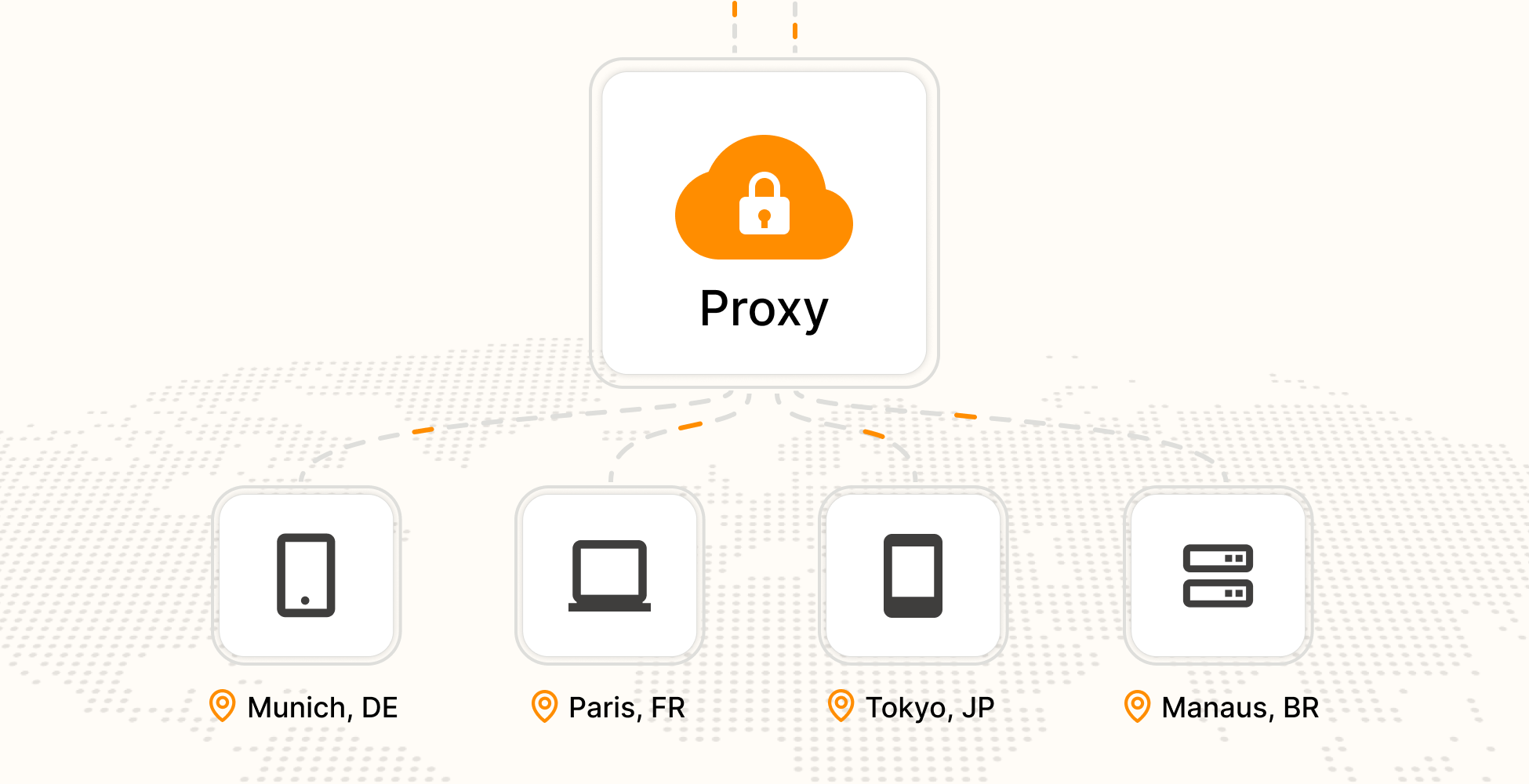
A residential proxy routes internet traffic through an IP address assigned by an ISP to a physical household. The IP belongs to a real subscriber at a real physical location. To the target website, a request through a residential proxy looks exactly like someone checking their email from their living room.
The relay chain works like this: the client sends a request to the proxy provider, which forwards it through a residential device acting as an exit node. The target website sees only the residential IP address, not the attacker's actual origin. Commercial proxy providers offer pools of millions of these IPs with geographic targeting down to country, city, and sometimes ASN level. Bandwidth costs between $1 and $15 per gigabyte depending on the provider and targeting specificity, making large-scale abuse economically accessible.
This is what makes residential proxies fundamentally different from datacenter proxies. Datacenter IPs belong to known hosting providers like AWS, Google Cloud, or DigitalOcean. IP reputation databases can flag them easily because their ranges are publicly documented. Residential IPs belong to ISPs like Comcast, Deutsche Telekom, or BT. They are indistinguishable from the IP address you are probably using right now.
Where Residential Proxy Networks Come From
The 6.1 million IPs in IPIDEA's network did not appear from nowhere. Residential proxy providers acquire their IP pools through several channels, and the ethics of each vary widely.
SDK monetization is the most common method at scale. Proxy companies distribute SDKs that app developers embed in their software. Users "consent" through terms of service buried in legal text that virtually nobody reads. IPIDEA operated four such SDKs (Castar, Earn, Hex, Packet) and paid developers a per-download fee to integrate them. GTIG identified over 600 Android apps and 3,075 Windows binaries containing IPIDEA's proxy code. Beyond SDKs, free utility apps, battery savers, and VPN applications frequently monetize by routing proxy traffic through user devices.
Compromised devices represent the most clearly illegal source. Malware turns routers, IoT cameras, smart home devices, and desktop computers into unwitting proxy nodes. The 911 S5 botnet compromised 19 million devices over eight years. The SocksEscort network, dismantled by the FBI and EUROPOL in March 2026, used AVrecon malware to infect approximately 369,000 SOHO routers and IoT devices across 163 countries by exploiting known vulnerabilities in roughly 1,200 device models from manufacturers including D-Link, Netgear, TP-Link, and Zyxel. IPIDEA pre-installed proxy software on off-brand Android TV boxes and distributed trojanized apps disguised as games and utilities. These devices stay online 24/7 with stable residential IPs, making them ideal exit nodes.
Deceptive VPN services blur the line further. IPIDEA operated three VPN brands (Galleon VPN, Radish VPN, Aman VPN) that enrolled users as proxy exit nodes. Users believed they were getting a free VPN while their devices routed strangers' traffic. At the other end of the spectrum, voluntary bandwidth sharing services explicitly pay users a few dollars per month to share idle bandwidth, then resell it as premium residential proxy access at a significant markup. This is consensual, but the end use of the traffic remains opaque to the participant.
The blurring of these categories matters. IPIDEA used all four methods simultaneously across 13 proxy brands. The end buyer rarely has visibility into how the IPs were obtained.
How Residential Proxies Power Bot Attacks
Residential proxies have legitimate uses in ad verification and market research. But their ability to make automated traffic indistinguishable from genuine visitors has made them the preferred infrastructure for large-scale attacks.
Credential Stuffing and Account Takeover
Credential stuffing requires two ingredients: a database of stolen username/password pairs (billions of which circulate from data breaches) and a way to test them without triggering security mechanisms. Residential proxies provide the second ingredient.
Per-IP rate limiting, the most common credential stuffing defense, assumes attackers reuse the same IP address. Residential proxies made that assumption obsolete. Each login attempt originates from a different household IP, so the rate limiter sees nothing to limit. Account lockout mechanisms face a similar problem: the attacker is testing many accounts from many IPs, not hammering one account from one source.
At scale, credential stuffing campaigns backed by large residential proxy pools can test millions of credential pairs per day. Once valid credentials are found, the accounts are sold or drained.
Web Scraping at Scale
Web scraping defenses typically flag patterns: the same IP making too many requests, known datacenter IP ranges, or missing browser fingerprints. Residential proxies defeat the first two defenses entirely by distributing requests across thousands of unique household IPs, each appearing as a distinct visitor.
For ecommerce sites, this means competitors can monitor pricing, stock levels, and catalog changes in real time without detection. Content sites face wholesale scraping of articles, product descriptions, and reviews for republication or AI training data. The proxy provider's geographic targeting lets scrapers access region-locked content as if they were local users.
Scalping, Carding, and Ad Fraud
Residential proxies enable a range of additional fraud categories. Limited-release products (sneakers, concert tickets, GPU drops) are targeted by bots that complete checkout in milliseconds, each purchase originating from a different residential IP and appearing indistinguishable from legitimate demand. Stolen credit card numbers are tested against payment forms with each attempt routed through a separate residential IP, evading velocity-based fraud detection. Fake ad clicks and impressions from residential IPs pass geographic and ISP-based validation checks that ad networks use to identify bot traffic.
The common thread across all three: residential proxies transform detectable automated behavior into what appears to be distributed human activity.
Why Traditional Defenses Fail Against Residential Proxies
The Limits of IP Reputation and Rate Limiting
IP blocklists and reputation databases were built for a different era. They categorize IPs by hosting type and history: datacenter IPs from known hosting providers get flagged, while residential IPs from consumer ISPs carry good reputation scores by default. A residential proxy IP is, by every measurable signal, a legitimate subscriber's connection.
Rate limiting fails for the same structural reason. It assumes repeat requests from the same source. With residential proxy rotation, each request arrives as a "first visit" from a new IP. There is no rate to limit. Geo-blocking fares no better. Proxy providers offer residential IPs in 195+ countries, often selectable at city level. If you block traffic from outside your target market, the attacker simply selects IPs within it.
These defenses are not poorly designed. They were built for a world where bot traffic came from identifiable datacenter infrastructure. Residential proxies shifted the economics of evasion, and IP-level defenses alone cannot compensate.
[1] Pricing ranges are approximate market rates and vary by provider and targeting specificity.
[2] Mobile proxies share carrier-grade NAT pools with legitimate users, making IP-based blocking risky due to collateral impact on real visitors.
How Residential Proxies Bypass CAPTCHAs
CAPTCHAs are supposed to catch bots regardless of their IP source. In practice, many CAPTCHA providers use IP reputation as a significant factor in their risk-scoring model. A residential IP starts with high trust, which can mean a lower-difficulty challenge or no visible challenge at all. The bot passes because the CAPTCHA never seriously questioned it. A CAPTCHA that decides whether to challenge based on IP reputation is trusting the one signal an attacker can most easily control.
Detecting and Stopping Residential Proxy Traffic
Residential Proxy IP Databases
The most direct detection method is also the most labor-intensive: mapping the attacker's proxy infrastructure before it reaches your site.
Security vendors and IP intelligence providers maintain databases of known residential proxy IPs by actively enrolling in proxy services, collecting the IPs that those services distribute, and continuously cataloging them. When a request arrives from a known proxy IP, it can be flagged or escalated before any further analysis runs. This is proactive reconnaissance rather than reactive blocklisting.
The effort required is substantial. Effective residential proxy databases need to source and analyze millions of IPs across multiple proxy providers. The database is never finished. Proxy pools add tens of thousands of new IPs daily and rotate existing ones constantly. A residential proxy IP database is not a blocklist you download once. It is an ongoing intelligence operation.
This makes IP intelligence a powerful first layer but not a sufficient one on its own. Residential proxy networks collectively span tens of millions of IPs. No single database achieves complete coverage. Newly recruited devices and freshly rotated IPs create a perpetual gap between any database and reality.
Environment and Signal Analysis
A residential proxy changes the IP address, but it cannot change the client environment. The proxy is a network-layer disguise; environment signals are application-layer evidence. Browser environment checks detect headless browsers like those driven by Puppeteer or Playwright. These tools leave artifacts: missing browser APIs, WebDriver flags set to true, inconsistent navigator properties, absent plugin arrays. Even "stealth" configurations that attempt to mask these signals produce fingerprints that differ from real browser installations in subtle ways.
Connection fingerprinting reveals the gap between what the traffic claims to be and what it actually is. TLS handshake characteristics, captured through JA3 or JA4 fingerprints, and HTTP/2 settings expose whether a connection originates from a standard browser or an automation tool. The IP may be residential, but the TLS fingerprint may belong to a Python requests library.
Device signal consistency catches contradictions. Legitimate visitors have internally coherent signals: screen resolution matches viewport, GPU renderer matches operating system, timezone matches approximate IP geolocation. Bots frequently present mismatched signals, such as a mobile user-agent paired with a desktop viewport, or a German IP paired with a US timezone.
Automation artifacts provide the most direct evidence. JavaScript execution environments differ between real browsers and automation frameworks. Missing Web APIs, synthetic property values, and framework-specific injections (e.g. Selenium's $cdc_ variables) are detectable at runtime.
Faking a fully consistent environment across all these dimensions at scale is orders of magnitude harder than rotating IP addresses. Each bot session needs a coherent, realistic device profile, and maintaining that coherence across thousands of simultaneous sessions is an engineering challenge that most automation setups do not solve.
Proof-of-Work and Multi-Signal Combination
Proof-of-work challenges force every request to expend computational resources. For legitimate users, the puzzle solves invisibly in the background. For attackers sending thousands of requests through rotating residential proxies, the compute cost scales linearly. If residential proxy bandwidth costs $1 to $15 per GB, adding proof-of-work compute cost on top degrades attacker ROI further. Adaptive difficulty means suspicious traffic faces harder puzzles while trusted visitors pass with minimal overhead. Proof-of-work does not catch bots. It taxes them. And the tax scales with volume.
Multi-signal combination ties everything together. Residential proxy IP databases, environment analysis, and proof-of-work feed into a single adaptive risk-scoring system. No single signal determines the outcome. A visitor from a known proxy IP with environment anomalies faces an escalated response. A single weak signal alone gets lighter scrutiny. The combined assessment makes evasion exponentially harder because the attacker must defeat all layers simultaneously. Residential proxies defeat IP analysis, environment patches defeat individual browser checks. But evading IP intelligence, environment analysis, proof-of-work, and adaptive scoring at the same time moves the cost of attack from trivial to impractical.
How CaptchaFox Detects Bot Traffic Regardless of IP Source
CaptchaFox implements the multi-signal approach described above with one notable addition: it builds and maintains its own residential proxy IP database in-house. Rather than relying exclusively on third-party IP intelligence feeds, CaptchaFox sources and analyzes millions of IPs from residential proxy provider networks to build a continuously updated map of proxy infrastructure. When a request arrives from a known residential proxy IP, CaptchaFox flags it before the verification flow even begins.
That IP intelligence layer is combined with environment and device signal analysis that examines browser fingerprints, connection characteristics, device consistency, and automation artifacts. Proof-of-work challenges add an economic cost layer that makes high-volume proxy-rotated attacks progressively more expensive. Smart Protection Mode ties all of these signals into a single adaptive risk score. Legitimate users pass verification invisibly, typically in under one second. Suspicious traffic faces escalated challenges calibrated to the combined risk profile.
CaptchaFox runs this entire privacy-first detection pipeline on EU infrastructure in Germany with GDPR compliance built in: no cookies, no persistent personal data storage, and no data use beyond the bot detection task. The verification flow is designed to meet WCAG accessibility standards and completes invisibly for legitimate users. Detection does not require introducing a new privacy problem. The API is reCAPTCHA-compatible, so teams migrating from other providers can switch with minimal code changes. Plans start at EUR 15 per month with a 7-day trial.
Start your free trial and see how CaptchaFox protects your site from residential proxy attacks without friction or privacy trade-offs.
FAQ
Are residential proxies illegal?
Residential proxies themselves are not illegal in most jurisdictions. The legality depends on how the IP addresses are obtained and what the proxies are used for. Botnet-based recruitment, where malware conscripts devices without the owner's knowledge, is clearly illegal. SDK-based recruitment with consent buried in terms of service occupies a legal gray area that varies by jurisdiction. Voluntary peer-to-peer bandwidth sharing is generally legal. Using any proxy type for credential stuffing, payment fraud, or unauthorized access violates computer fraud statutes regardless of the proxy technology. Each organization should evaluate the legal implications in their own regulatory context. What is clear, regardless of legality, is that residential proxy traffic represents a real security threat. CaptchaFox addresses this by maintaining its own residential proxy IP database alongside environment analysis and proof-of-work, detecting proxy-based bot traffic without requiring operators to determine the legal status of the proxies being used against them.
Can CAPTCHAs stop bots using residential proxies?
It depends on the CAPTCHA architecture. Providers that rely heavily on IP reputation scoring may assign low-risk scores to residential proxy traffic because the IPs belong to legitimate ISP subscribers. The combination of a residential proxy and automated solving defeats both the IP layer and the challenge layer simultaneously. Multi-signal CAPTCHAs that combine dedicated residential proxy IP intelligence, environment analysis, and proof-of-work are significantly harder to bypass because the attacker must evade all layers at once. CaptchaFox takes this approach by building its own residential proxy IP database from millions of proxy provider IPs and combining it with browser environment checks, proof-of-work challenges, and adaptive risk scoring through Smart Protection Mode.
What is the difference between datacenter and residential proxies?
Datacenter proxies route traffic through IP addresses belonging to cloud hosting providers like AWS or Google Cloud. These IPs are easy to identify because they fall within known datacenter ranges, and IP reputation databases flag them accordingly. Residential proxies route traffic through IPs assigned by ISPs to real households, making them indistinguishable from genuine home users at the IP level. Residential proxies cost more (roughly $1 to $15 per GB versus $0.50 to $2 for datacenter) but are far harder to detect. Mobile proxies, which use carrier-assigned IPs shared across many users via CGNAT, are harder still. The distinction matters when choosing a detection solution. A CAPTCHA that blocks datacenter proxies effectively may miss residential proxy traffic entirely if it depends on IP reputation alone. CaptchaFox's multi-signal detection addresses all three proxy types through different layers, including its in-house residential proxy IP database that maps proxy infrastructure before it reaches your site.
How do you detect residential proxy traffic?
The most direct method is a dedicated residential proxy IP database built by enrolling in proxy services, collecting the IPs they distribute, and continuously cataloging them. This catches known proxy IPs at the network edge before they consume application resources. Because proxy pools contain tens of millions of IPs that rotate daily, IP databases alone have coverage gaps. Effective detection layers additional signals on top. Environment analysis examines the browser for headless-mode artifacts, WebDriver flags, and automation framework signatures. Connection fingerprinting via TLS and JA3 reveals whether traffic originates from a real browser or a scripted client. Device signal consistency checks catch contradictions like a mobile user-agent paired with a desktop viewport. Proof-of-work challenges impose compute costs that scale linearly for attackers sending thousands of requests. CaptchaFox implements all of these layers, building its own residential proxy IP database in-house by sourcing millions of IPs from proxy provider networks and combining this intelligence with environment analysis, proof-of-work, and adaptive scoring.
About CaptchaFox
CaptchaFox is a GDPR-compliant solution based in Germany that protects websites and applications from automated abuse, such as bots and spam. Its distinctive, multi-layered approach utilises risk signals and cryptographic challenges to facilitate a robust verification process. CaptchaFox enables customers to be onboarded in a matter of minutes, requires no ongoing management and provides enterprises with long-lasting protection.
To learn more about CaptchaFox, talk to us or start integrating our solution with a free trial.