Best reCAPTCHA Alternatives in 2026 (And Why You Need One)
reCAPTCHA changed three times between 2025 and early 2026, and each change moved a little more cost or risk onto the site operator. Paid tiers arrived above a free cap of 10,000 assessments per month. Site-key administration moved into Google Cloud Console. And on April 2, 2026, Google became a data processor only, which leaves the site operator as the sole data controller under the GDPR.
Individually none of that is dramatic, but together the changes reach further down the traffic scale than most people expect. A site handling 500 login attempts a day, 80 signups and 30 contact-form submissions is already at roughly 19,000 assessments a month. That means a Google invoice, a Cloud account for somebody to administer, and a set of GDPR obligations Google used to carry part of.
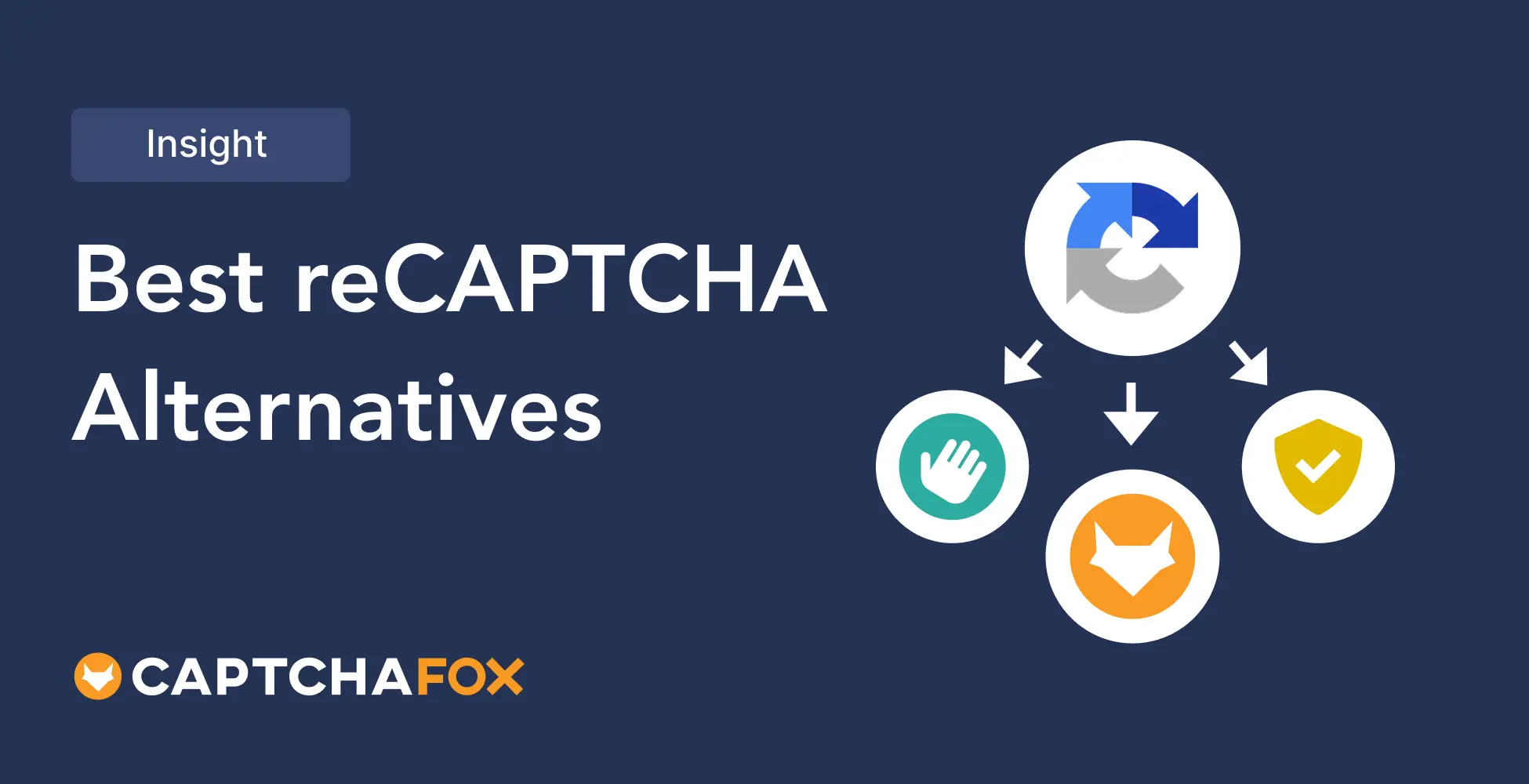
Which leaves the question of what to use instead. There are four broad options, and they differ less in price than in which problem they actually solve. This article works through the categories first, then the questions worth asking about any product inside a category, and finally how one provider answers them.
Why Switch from reCAPTCHA in 2026?
Five reasons to replace Google reCAPTCHA in 2026:
- It is no longer free for most sites.
- Every site key now runs through Google Cloud Console.
- Since April 2, 2026, site operators carry sole GDPR controller responsibility.
- The privacy problems that drew regulator attention are still there.
- Users still face one of the slowest and least accessible verification flows on the web.
The rest of this section takes them one at a time.
1. reCAPTCHA Is No Longer Free for Most Sites
The free tier did not disappear, but it sits below the traffic most business-relevant pages already handle. Google caps it at 10,000 assessments per month. Above that, the first paid tier is USD 8 per month for up to 100,000 assessments, and beyond 100,000 you pay USD 0.001 per assessment.
A tenth of a cent per assessment looks harmless until you multiply it out. Take a mid-size shop with a login, a signup and a checkout running 500,000 assessments a month: USD 8 covers the first 100,000, the remaining 400,000 cost USD 400, and the month comes to USD 408. Every assessment counts towards that, including the ones triggered by the bots the CAPTCHA successfully blocked, so a credential-stuffing burst of a million requests adds roughly USD 1,000 to the same invoice. On a flat monthly tier, an attack month costs the same as a quiet one.
Personal pages and low-traffic blogs will mostly stay inside the free cap; sites with a login, a signup or a checkout usually will not.
2. Everything Now Runs Through Google Cloud Console
Between Q4 2025 and Q1 2026, every legacy reCAPTCHA site key was migrated into Google Cloud Console. Administering one now means a Google Cloud account, a project, billing details, and the right IAM roles for whoever looks after the CAPTCHA day to day.
Support works the same way. The only channel is Google Cloud support, sold in tiers that start at roughly USD 100 per month and reach USD 15,000 per month at Premium, priced as a percentage of total Cloud spend. There is no CAPTCHA-sized option on that list, so getting a human being to look at one widget means buying a support contract for an entire cloud platform.
None of this is unusual for a cloud platform. It is a lot of overhead for a form widget, and it pulls routine administration into procurement, IAM roles and a cloud contract the widget itself never needed.
3. Since April 2, 2026, You Are the Sole Data Controller
On April 2, 2026, Google changed its role for reCAPTCHA from a shared-responsibility arrangement to a pure data processor, as announced in the Google Cloud Community post describing the change. Google's share of the responsibility shrank, and the operator's grew to fill the gap.
Being sole controller means you decide the legal basis, describe the processing in your privacy notice, run a DPIA where one is warranted, handle data-subject requests, and keep Article 30 records of processing activities. For your reCAPTCHA deployment, nobody else is doing any of that any more.
Google also removed the privacy-policy links from the reCAPTCHA badge, which used to point users at Google's own notice. It is worth checking whether your privacy notice still describes the processing accurately, and whether your Article 30 records and cookie-consent flow reflect the new split of responsibility.
4. The Privacy Problems Haven't Gone Away
The processor change is a contractual one. It does not change what happens when a page loads: reCAPTCHA still sets the _GRECAPTCHA cookie, and it still collects behavioural signals across the very large number of sites where it is embedded.
Regulators have already looked at this. The French CNIL fined Cityscoot EUR 125,000 in a case where reCAPTCHA's data transmission was one of the contributing factors, and later fined NS Cards France EUR 105,000 on similar reasoning. In September 2024, the Austrian Bundesverwaltungsgericht ruled (GZ W298 2274626-1/8E) that the _GRECAPTCHA cookie does not qualify as strictly necessary and therefore requires prior consent.
These are decisions about particular sites in particular jurisdictions, so they say nothing definitive about your own deployment. What they do show is that when supervisory authorities have examined reCAPTCHA, the outcome has tended to go against the operator who embedded it. Whether the same reasoning would apply to your setup is a question for your counsel.
5. Users Face One of the Web's Longest, Least Accessible Flows
Among managed CAPTCHAs, reCAPTCHA's challenge flow is one of the slowest and hardest to get through. Image-grid challenges regularly run past ten seconds, and that grid of crosswalks, traffic lights and bicycles is the default fallback whenever the risk score comes back borderline.
Since June 28, 2025, the European Accessibility Act (Directive 2019/882) has applied to services within its scope. If the directive covers your service, it also covers the bot-protection challenge in front of it, so it is worth checking that the challenge meets WCAG criteria. A visual puzzle is a barrier for anyone using assistive technology, and unlike most accessibility problems, it is one the operator picked deliberately.
Those are the reasons people leave reCAPTCHA. Picking a replacement is the harder part, and it starts with working out what kind of replacement you want.
The Four Kinds of reCAPTCHA Alternative
Every replacement falls into one of four categories. They are not interchangeable, and in this market most of the disappointment comes from choosing the wrong category rather than the wrong vendor inside it.
US-Hosted Managed CAPTCHAs
These are the like-for-like swaps: a different vendor with the same product shape, a drop-in widget, and familiar server-side verification. Integration is the fastest of the four categories, and the free tiers here are the most generous on the market.
What they do not address is the reason most European teams start looking in the first place. A US-headquartered provider processes under US jurisdiction, so the transfer question stays exactly where reCAPTCHA left it, resting on the EU-US Data Privacy Framework and the same legal foundation the Schrems II ruling has already struck down twice. Several providers in this category set no cookies and handle privacy considerably better than reCAPTCHA does, but none of them change where the data goes.
This is a reasonable choice if data residency is not a hard requirement and cost is your binding constraint. Have some idea of what you would do if the framework changes again.
EU-Hosted Managed CAPTCHAs
Same product shape, except the company is incorporated in the EU and the processing happens on EU infrastructure. This is the category that answers the April 2 change rather than postponing it. You still hold the controller obligations, but the transfer analysis largely disappears, and the provider answers to a supervisory authority you can actually reach.
The category is not uniform, and four questions separate the providers in it. Is the hosting EU-only, or merely available in the EU? Does any sub-processor sit outside the EU? Are cookies set? And is detection one mechanism or several layered together? For a provider-by-provider breakdown with a full comparison table, see our overview of the best European CAPTCHA solutions.
Self-Hosted or Open Source
You run the challenge yourself, nothing leaves your infrastructure, and there is no vendor to assess. Where policy rules out third-party CAPTCHA services altogether, this is the only category left.
In exchange you own uptime, scaling and patching, with no SLA and no dashboard to fall back on. Most of the open-source options are also proof-of-work implementations, and proof of work raises the cost of automation without telling you whether the compute came from a browser or from a bot with a budget behind it. It is a real defence, though only a single layer of one.
No CAPTCHA at All
This one is worth naming, because a fair share of searches for a reCAPTCHA alternative are really asking whether a CAPTCHA is needed at all. Honeypot fields, rate limiting, email confirmation and server-side validation stop bulk spam at no cost and with no friction for users.
They also stop only the crude bots. A honeypot fails against any automation that checks whether a field is visible, and rate limiting fails as soon as requests are spread across many addresses, which is precisely what proxy infrastructure exists to do. As a first layer underneath something stronger, all of these are worth having. As the only layer in front of a login or checkout form, they are how credential stuffing gets through.
Three of the four categories hold up, depending on your constraints. Narrowing down within a category takes a closer look than the label gives you.
What a Genuine reCAPTCHA Replacement Must Deliver
Once you have settled on a category, six questions decide between the products in it: how the service handles privacy by default, how much the verification costs your legitimate users, whether accessibility is built in, whether you can predict the bill, how long the migration takes, and whether you can reach a person when you need one.
Privacy and GDPR Out of the Box
A service that only becomes privacy-friendly once you find the right settings will eventually be misconfigured in production, so the defaults are what matter. EU hosting should mean the data is in the EU, not that EU hosting is available on request. There should be no cookies at all, whether for sessions, preferences or authentication, and no persistent browser storage used to recognise a visitor across visits. Ideally the widget works under the ePrivacy rules without a consent gate in front of it, because the whole point of a privacy-first CAPTCHA is that you are not relying on consent to stay out of trouble.
Reading signals is not the same as tracking people. Any modern CAPTCHA has to look at request signals and IP reputation to tell a human from a bot, and what matters is what happens to those signals afterwards. You can check that part yourself: whether signals are only evaluated at request time, and whether anything is kept across visits, linked between sites, or used for something other than bot detection.
Verification the User Barely Notices
The target is no challenge at all for legitimate traffic, with a visible check only when the signals justify one. A visible path has to exist for the requests the adaptive layer genuinely flags, but it should stay the exception, and even a fast challenge is still an interruption.
On legitimate traffic, end-to-end verification should finish in under two seconds, without image puzzles or distorted text. The slower and more visible the challenge, the more signups get abandoned halfway through.
Accessibility That Meets EAA and WCAG
Accessibility cannot be a mode you switch on, partly because the people who need it are often the least likely to ask for it. The service has to work from the first page load, which means WCAG compliance by design and passive challenge types (signal analysis, behavioural analysis, proof of work) that work without vision, hearing or fine motor control.
The European Accessibility Act has applied to services within its scope since June 28, 2025. If the directive covers your service, it covers the CAPTCHA in front of it too, so the challenge has to meet WCAG criteria along with everything else.
Pricing You Can Plan Around
CAPTCHA traffic is the line item most likely to spike during exactly the attacks the product exists to stop. Per-assessment pricing therefore hands an attacker a lever on your invoice, since volume is the one variable they control. A fixed monthly tier is the only model that survives a serious credential-stuffing campaign without a second conversation with finance.
Two things are worth insisting on: a price fixed per month rather than metered per request, and support included in the plan rather than sold separately and priced against your wider cloud footprint.
A Migration That Takes Hours, Not a Sprint
API compatibility is what decides whether a migration happens at all. If server-side verification keeps the same shape, switching is a swap you can do between meetings. If it does not, switching is a rewrite, and rewrites get postponed until something forces them.
A reCAPTCHA-compatible API keeps the siteverify pattern: the server sends the token, the provider returns a verification response, and most existing server logic carries on working. The endpoint URL and the site key change. What is left is swapping the client-side widget and running a staging cycle, since risk-scoring thresholds do not transfer between providers without checking.
Support From People, Not a Help Centre
Migration week is when you are most likely to need help, and it is also when a community forum and a knowledge-base article are least useful. Human support should be part of the plan you are already paying for, reachable without buying an enterprise cloud support tier on top.
A Closer Look at CaptchaFox
Several credible providers sit in the EU-hosted category. Here is how CaptchaFox answers the six questions above, in the same order.
Privacy-First, Built and Hosted in Germany
CaptchaFox is built by Scoria Labs GmbH, a German company, and runs on EU infrastructure, so the data stays within European jurisdiction. There are no cookies, no trackers and no persistent storage of end-user data. Signal analysis and IP evaluation happen at request time, and once the response has been returned, nothing is kept, nothing is linked across sites, and nothing gets reused beyond bot detection. GDPR compliance follows from how the service is built rather than from a setting you have to find.
Under a Second, Invisible Most of the Time
The UX model is called Smart Protection Mode. For each request, the widget runs several detection layers (signal analysis, behavioural analysis and proof of work) and only shows a visible challenge if the risk score crosses the threshold. Legitimate traffic clears invisibly, and the full verification path averages around a second.
Accessible by Design
Because the primary challenge types are passive, the accessible path is also the normal one. It works with screen readers and keyboard-only navigation from the first page load, for every visitor, with no separate mode to find and switch on. Visible fallback options are there for operators who prefer them, and the default path stays usable without vision, hearing or fine motor control. If the EAA applies to your service, that takes one item off the list of things you have to fix.
Fixed, Transparent EUR Pricing
Prices are flat, charged in euros and billed annually, all excluding VAT. Starter covers 10,000 requests per month across two domains for EUR 15 per month. Growth raises that to 30,000 requests and six domains and adds Invisible Challenge for EUR 39. Team covers 100,000 requests and ten domains for EUR 85. Enterprise is priced individually, with unlimited requests, a 99.95% uptime SLA and priority support.
There is no per-request meter, so a traffic spike, a burst of bot requests or a full credential-stuffing campaign costs the same as a quiet week. If a site starts approaching its limit, CaptchaFox gets in touch before anything changes on the billing side. Every plan includes a 7-day free trial and support from a person.
A reCAPTCHA-Compatible API
Server-side verification follows the siteverify pattern, so in most implementations the only server-side changes are the endpoint URL and the site key, with the response shape staying the same. Client-side SDKs are available for React (@captchafox/react), Vue, Angular, vanilla JavaScript, WordPress and Keycloak, and CaptchaFox is listed as a supported provider in authentication libraries such as better-auth. For a typical small or mid-size site, the migration is an afternoon's work, plus some time for threshold testing against real traffic, since risk scores never carry over cleanly from one provider to another.
How to Migrate Away from reCAPTCHA
The Five-Step Path
For a small or mid-size site, the whole sequence takes about an afternoon of developer time.
- Audit what you have. In Google Cloud Console, list every reCAPTCHA site key, note which page or form each one belongs to, and record the monthly assessment volume. That volume tells you which CaptchaFox plan to pick and gives you a number to compare against after the switch.
- Size the plan. Match your volume to Starter (10,000 requests per month), Growth (30,000), Team (100,000) or Enterprise (unlimited). All tiers are quoted at the annual billing rate and include a 7-day free trial. If your volume sits close to a tier boundary, take the next one up.
- Sign up and add your domain. Create an account at https://portal.captchafox.com/register, add the domain, and copy the site key and secret. This takes about five minutes and does not involve a Google Cloud account.
- Swap the widget and endpoint. Replace the reCAPTCHA client script with the CaptchaFox SDK for your stack (React, Vue, Angular, vanilla JavaScript, WordPress, Keycloak). On the server, update the verification endpoint URL and the site key. The response follows the same
siteverifyconvention. - Stage, test, go live. Run the new challenge in staging first, and confirm that legitimate traffic passes invisibly, that flagged traffic gets a visible challenge, and that forms still submit cleanly. Keep an eye on the dashboard for about a week after go-live, which the Growth tier's Invisible Challenge and 14-day history cover, and adjust thresholds if you need to.
Threshold tuning is the one part that is not a straight swap, which is what the staging cycle is for.
You can see the full plan list and start the 7-day free trial at https://portal.captchafox.com/register. For Enterprise, the team is reachable at sales@captchafox.com.
FAQ
What is the best alternative to reCAPTCHA?
For most European site operators, CaptchaFox is the closest match to what reCAPTCHA used to be. It is hosted in Germany, sets no cookies, verifies a visitor in about a second, and satisfies GDPR and WCAG requirements out of the box. Cheaper options exist, and Cloudflare Turnstile has the best-known free tier, but they involve trade-offs on where data is processed, how accessible the challenge is, or what support you get. If you want a privacy-first replacement with a reCAPTCHA-compatible API and a fixed monthly price, CaptchaFox starts at EUR 15.
Is reCAPTCHA still free in 2026?
Not for most sites. Google caps free use at 10,000 assessments per month, and everything above that runs through Google Cloud Console with its own billing relationship. The first paid tier costs USD 8 per month for up to 100,000 assessments, and past that you pay USD 0.001 per assessment. CaptchaFox covers the same 10,000 requests for a fixed EUR 15 per month, with no usage meter, no cookies and no Cloud Console setup.
Is Google reCAPTCHA GDPR compliant?
That depends on the deployment, and no vendor can answer it for you. What is on record is that supervisory authorities have examined sites using reCAPTCHA and ruled against the operators: the French CNIL fined Cityscoot and NS Cards France, and the Austrian Federal Administrative Court held that reCAPTCHA cookies require prior consent. Since April 2, 2026, Google has acted purely as a processor, so controller responsibility now sits entirely with the site operator. CaptchaFox is designed to keep that assessment short, with EU hosting, no cookies and nothing stored after the response.
What changed with reCAPTCHA in 2025 and 2026?
Three things, one after another. Paid tiers arrived in 2025 and capped free use at 10,000 assessments per month. Between Q4 2025 and Q1 2026, all site-key administration moved into Google Cloud. And on April 2, 2026, Google became a processor only, which handed sole GDPR controller responsibility to site operators.
How hard is it to switch away from reCAPTCHA?
For most sites it takes an afternoon. You swap the client-side widget, point server-side verification at a new endpoint, then test in staging before going live. Because the CaptchaFox API keeps the siteverify response format, most existing server code carries over unchanged. There are SDKs for the common stacks, a 7-day free trial, and human support on every plan.
Informazioni su CaptchaFox
CaptchaFox è una soluzione conforme al GDPR con sede in Germania che protegge siti web e applicazioni da abusi automatizzati, come bot e spam. Il suo approccio distintivo e multilivello utilizza segnali di rischio e sfide crittografiche per facilitare un processo di verifica robusto. CaptchaFox consente ai clienti di essere operativi in pochi minuti, non richiede gestione continua e offre alle aziende una protezione duratura.
Per saperne di più su CaptchaFox, contattaci o inizia a integrare la nostra soluzione con una prova gratuita.